


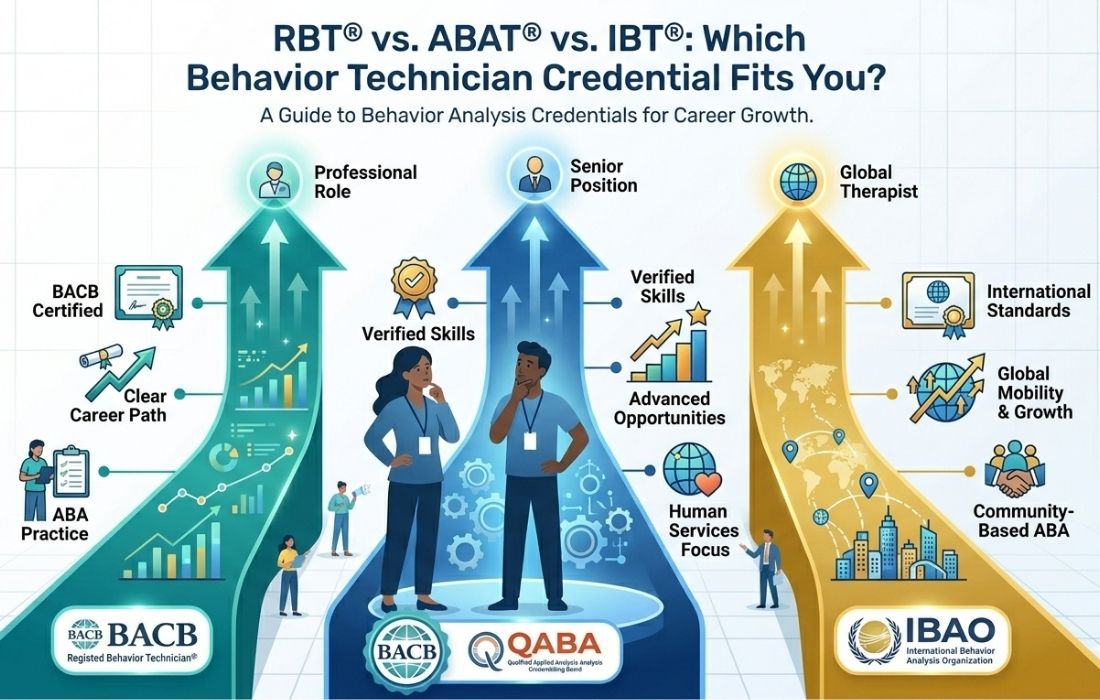
You Googled it. You saw three options. Now you’re staring at RBT®, ABAT®, and IBT® wondering what the difference actually is — and more importantly, which one is right for you.
Here’s the truth: all three are legitimate entry-level behavior technician credentials. All three require a 40-hour training, an exam, and ongoing supervision. But they come from different credentialing boards, they’re recognized in different settings, and they each open different doors for your career.
This guide breaks down every major difference — so you can stop second-guessing and start training.
The Quick Answer: RBT® vs. ABAT® vs. IBT®
Before we dive deep, here’s the high-level comparison:
| RBT® | ABAT® | IBT® | |
| Issued By | BACB | QABA | IBAO |
| Best For | U.S. & Canada | U.S. + Global | International |
| Exam Format | In-person (Pearson VUE) | Remote Proctored | Remote Proctored |
| Supervision Required | BCBA / BCaBA | QBA / QASP-S | IBA |
| Career Pathway | BCaBA → BCBA | QASP-S → QBA | IBA pathway |
| OTB Cost | Starting at $100 | Starting at $100 | Starting at $100 |
| Compliance (2026) | BACB 2026 Compliant | QABA Aligned | IBAO Approved |
The RBT®: The Most Recognized U.S. Credential
| 🎯 RBT® — Registered Behavior Technician | |
| Governing Body | Behavior Analyst Certification Board (BACB) |
| Who Supervises You | BCBA, BCBA-D, or BCaBA |
| Exam Format | 85 questions, in-person at Pearson VUE testing center |
| Passing Score | Approximately 68% correct (scaled scoring) |
| Renewal | Annual — requires 1 supervisory observation per month + renewal fee |
| Career Advancement | BCaBA → BCBA |
| OTB Training | RBT® Pathway — BACB Task List aligned, BACB 2026 Compliant |
The RBT® is the gold standard for behavior technicians in the United States. If you’re working — or planning to work — in a U.S.-based ABA clinic, school district, or insurance-funded setting, there’s a good chance your employer specifically requires an RBT®.
The BACB is the most widely recognized credentialing body in North America, and the RBT® has become the default entry-level credential in most U.S. states. It’s also the foundation of the BACB’s career ladder: RBT® → BCaBA → BCBA.
Who Should Choose the RBT®?
- You’re based in the United States or Canada
- Your employer or state funding source specifically requires BACB credentials
- You want to eventually pursue your BCBA or BCaBA
- You’re comfortable testing in-person at a Pearson VUE center
- You’re working under direct BCBA or BCaBA supervision
✦ Outside the Box Trainings’ RBT® Pathway is BACB 2026 Compliant and aligned with the RBT® Task List 3rd Edition — the new standard effective January 1, 2026.
The ABAT®: The Flexible, Global-Friendly Alternative
| 🌍 ABAT® — Applied Behavior Analysis Technician | |
| Governing Body | Qualified Applied Behavior Analysis Credentialing Board (QABA) |
| Who Supervises You | QBA, QASP-S, or master’s-level licensed professional |
| Exam Format | Remote proctored — no testing center required |
| Exam Domains | 7 official QABA content domains |
| Renewal | Annual — CE requirements vary |
| Career Advancement | QASP-S → QBA |
| OTB Training | ABAT® Pathway — QABA Aligned |
The ABAT® is issued by QABA — the Qualified Applied Behavior Analysis Credentialing Board — an ANAB-accredited organization that’s been growing rapidly in recognition, especially in school-based and community settings.
One of the ABAT’s biggest advantages: the exam is fully remote-proctored. No Pearson VUE center, no in-person testing. If you live in a rural area or a country without nearby testing facilities, this alone can be a game-changer.
The ABAT also allows supervision by a broader range of professionals — including QASP-S and QBA supervisors, and even some master’s-level licensed clinicians depending on your state or country. This makes it a practical choice for technicians whose workplace doesn’t follow the BACB supervision model.
Who Should Choose the ABAT®?
- You prefer remote proctored testing over in-person Pearson VUE
- You’re supervised by a QBA, QASP-S, or non-BACB licensed professional
- Your employer or organization uses the QABA credentialing system
- You’re interested in the QABA career ladder: ABAT® → QASP-S → QBA
- You work in a school or community setting that accepts QABA credentials
- You’re outside the U.S. but want international recognition
✦ QABA offers a stackable credential system. ABAT® is just the start — you can advance to QASP-S and QBA without switching boards.
The IBT®: Built for the International Field
| 🌐 IBT® — International Behavior Therapist | |
| Governing Body | International Behavior Analysis Organization (IBAO) |
| Who Supervises You | International Behavior Analyst (IBA) |
| Exam Format | Remote proctored |
| Focus | Foundational ABA knowledge; broader applications across settings |
| Best Settings | International clinics, educational programs, multilingual contexts |
| Career Advancement | IBA pathway |
| OTB Training | IBT® Pathway — IBAO Approved |
The IBT® is issued by the International Behavior Analysis Organization (IBAO) and is designed specifically for technicians working in global, multilingual, or non-BACB environments. It focuses on foundational ABA knowledge and is often used in educational settings or countries where ABA is being introduced and formalized.
If you’re working outside the United States — in Latin America, Europe, Asia, or the Middle East — and ABA services in your country don’t require a BACB credential, the IBT® may be the most practical and accessible path forward.
The IBT® also covers a broader application of ABA principles beyond clinical autism services, making it a fit for behavior technicians working in schools, NGOs, or community development contexts.
Who Should Choose the IBT®?
- You’re working or planning to work outside the United States
- Your country or organization doesn’t require BACB or QABA credentials
- You work in educational or community settings with broader ABA application
- You want a foundational credential with global portability
- You’re supervised by an International Behavior Analyst (IBA)
✦ OTB’s IBT® Pathway is IBAO Approved — so your Certificate of Completion is accepted by the IBAO when you apply for your credential.
Can You Hold More Than One Credential?
Yes — and some technicians do. Holding both an RBT® and an ABAT®, for example, can make you more competitive in job markets where employers vary in which credentialing board they follow. Some technicians pursue all three to maximize their career flexibility, especially if they work across settings or plan to practice internationally.
That said, for most people starting out, one credential is the right move. Choose the one that matches where you’re working now and the career path you want to build.
So… Which One Should You Choose?
Use this decision tree:
- Working in the U.S. under a BCBA or BCaBA, or want to become a BCBA one day? → RBT®
- Prefer remote testing, or work under QABA supervision, or in a school setting? → ABAT®
- Working outside the U.S. or in a country without established BACB/QABA structures? → IBT®
- Not sure? → Start with the RBT® if you’re in the U.S. It’s the most universally accepted.
✦ All three pathways at Outside the Box Trainings start at $100, include The Mic Check mock exam, a Certificate of Completion, and 3 PDUs redeemable after certification. Same investment, different doors.
Frequently Asked Questions
Is the RBT® better than the ABAT®?
Not universally — it depends on your setting and career goals. In the U.S., the RBT® is more widely recognized by employers and insurance providers. But the ABAT® is growing in recognition, offers remote testing, and leads to its own advanced credential pathway. Neither is objectively better; the right one depends on your situation.
Can I get the ABAT® if I’m in the United States?
Absolutely. The ABAT® is available to technicians in the U.S. and is recognized in many school-based and community settings. Some technicians choose it specifically for the remote proctoring option or because their employer or supervising QBA operates within the QABA system.
What’s the difference between IBT® and RBT®?
The RBT® is issued by the BACB and is primarily recognized in the U.S. and Canada. The IBT® is issued by the IBAO and is designed for international settings. The day-to-day work is similar, but the supervising structure, exam format, and geographic recognition differ significantly.
Does Outside the Box Trainings offer all three pathways?
Yes. OTB offers a dedicated 40-hour training pathway for the RBT®, ABAT®, and IBT®. All three are included in The Behavior Technician Mixtape — 10 modules, self-paced, starting at $100 each.
What if I’m not sure which credential my employer requires?
Ask your hiring manager or supervising analyst before you enroll. Most job postings will specify which credential they require or prefer. If your employer hasn’t specified, the RBT® is the safest default choice in U.S.-based settings.
What if I’m not sure which credential my employer requires?
Ask your hiring manager or supervising analyst before you enroll. Most job postings will specify which credential they require or prefer. If your employer hasn’t specified, the RBT® is the safest default choice in U.S.-based settings.
Ready to Choose Your Pathway?
The credential you choose shapes your career — but the training that gets you there matters just as much. Outside the Box Trainings offers culturally responsive, self-paced 40-hour training across all three pathways, built for the next generation of behavior technicians.
The Behavior Technician Mixtape is live. One platform. Three pathways. Your career starts here.