


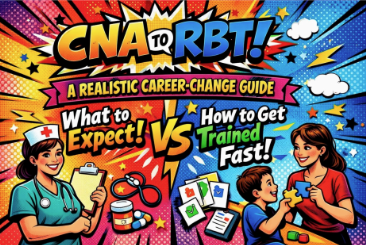
CNA burnout is real, but your caregiving skills are a perfect match for the ABA field. Here’s your realistic guide to remixing your healthcare experience into a rewarding RBT career—without starting from zero.
You didn’t become a CNA because you wanted easy money. You did it because you actually care
about people. You wanted to make a difference, and you have.
But let’s be real for a second.
The burnout is real. The short staffing is real. The feeling that you’re running on empty while giving
everything you’ve got? Very real.
If you’ve been Googling “careers similar to CNA” or “how to leave healthcare without starting over”,
you’re in the right place. Because becoming a Registered Behavior Technician (RBT) might be the piv-
ot you didn’t know you were looking for.
This isn’t about abandoning your skills. It’s about remixing them.
Why CNAs Make Incredible RBTs (Seriously)
Here’s what nobody tells you: the skills you’ve built as a CNA are exactly what the ABA field needs.
Think about it.
You already know how to:
- Read body language and nonverbal cues
- Stay calm when things get chaotic
- Build trust with people who are vulnerable
- Document everything (because if it’s not charted, it didn’t happen)
- Work as part of a care team
That’s not entry-level stuff. That’s a whole foundation.
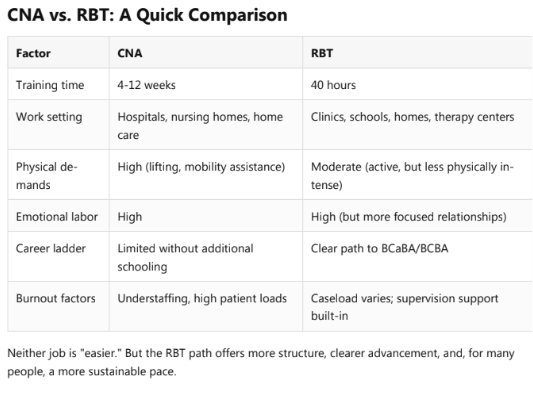
As a CNA, you’ve been trained to observe, respond, and adapt, often in high-pressure situations. RBT
work requires the same instincts, just applied differently. Instead of vital signs and mobility assistance,
you’re tracking behaviors and implementing intervention plans designed by a Board Certified Behav-
ior Analyst (BCBA).
You’re not starting from zero. You’re building on what you’ve already mastered.
It’s like Kendrick said, “sit down, be humble.” But also? Know your worth. Your experience matters
here.
What Does an RBT Actually Do All Day?
Let’s cut through the jargon.
As an RBT, you work directly with clients, often kids, but sometimes adults, who have autism spectrum
disorder or other developmental and behavioral needs. You’re implementing behavior intervention
plans, teaching skills, collecting data, and being a consistent, supportive presence.
Here’s what a typical day might look like:
- Morning: You arrive at a client’s home or a clinic. You review the session goals and prep any ma-
terials. - Session time: You work one-on-one with your client, running through skill-building activities.
Maybe it’s communication practice, social skills, or daily living tasks, depends on their plan. - Data collection: You track progress in real-time. Every response, every behavior, every win gets
documented. - Team check-in: You might debrief with a supervising BCBA to discuss what’s working and what
needs tweaking.
The pace is different from CNA work. You’re not running between ten rooms. You’re focused, present,
and building real relationships with the people you serve.
And that connection? It hits different when you see a kid use a communication device for the first
time or finally master a skill they’ve been working on for months.
The 40-Hour Training: What It Actually Involves
Okay, let’s talk logistics, because that’s probably why you clicked.
To become an RBT, you need to complete a 40-hour training program that covers the fundamentals
of Applied Behavior Analysis (ABA). This is a requirement set by the Behavior Analyst Certification
Board (BACB), and it’s non-negotiable.
But here’s the good news: 40 hours is doable. We’re not talking about going back to school for two
years.
The training covers:
- Measurement and data collection , how to accurately track client progress
- Behavior reduction strategies , ethical, evidence-based ways to address challenging behaviors
- Skill acquisition , teaching new skills using ABA techniques
- Professional conduct and ethics , because this field takes boundaries seriously
- Documentation , you already know this one
After you complete the training, you’ll need to pass the RBT certification exam and work under the
supervision of a BCBA. That’s it. No four-year degree required. No massive student loan debt.
The right training program makes all the difference, though. You want something that’s actually en-
gaging, not a 40-hour slideshow that puts you to sleep. Real-life scenarios. Practical examples. Con-
tent that sticks.
That’s the Outside the Box Trainings approach. We call it the Mixtape Method, training that blends
pop culture, real-world application, and actual engagement. Because learning shouldn’t feel like a
punishment.
Let’s Talk Money (Because We Have To)
Real talk: RBT salaries vary depending on where you live and where you work.
The national average sits around $36,218 per year, but that number shifts based on setting (clinic vs.
home-based vs. school), location, and experience level.
Is it a massive jump from CNA pay? Depends on your current situation. But here’s the bigger picture:
RBT is a launchpad.
Many RBTs use this role as a stepping stone to:
- Lead RBT or Senior RBT positions with supervisory responsibilities
- Board Certified Assistant Behavior Analyst (BCaBA) certification
- Board Certified Behavior Analyst (BCBA) , where average salaries hit around $68,554
The ABA field is growing fast, demand for autism professionals is projected to increase by 31%
through 2029. That’s not hype. That’s job security.
How to Get Started (Like, Actually)
If you’re ready to make the move, here’s your game plan:
Step 1: Complete a 40-hour RBT training program. Find one that’s BACB-approved and actually
engaging. Boring training leads to poor retention: and you need this stuff to stick when you’re in ses-
sion.
Step 2: Pass the RBT certification exam. It’s a competency-based test. If you did the training right,
you’ll be prepared.
Step 3: Get hired and start working under BCBA supervision. Many ABA agencies hire RBT candi-
dates who are in the process of getting certified. Your CNA background makes you a strong candi-
date.
Step 4: Keep learning. Continuing education units (CEUs) aren’t just a requirement: they’re how you
stay sharp and advance. Think of it as leveling up, not checking boxes.
You’re Closer Than You Think
Career changes are scary. Especially when you’ve put years into building skills in one field.
But here’s the thing: you’re not throwing those years away. You’re evolving.
The patience you developed during 12-hour shifts? Transfers. The empathy you built caring for vul-
nerable people? Transfers. The ability to stay calm when everything’s going sideways? Definitely
transfers.
You’ve been doing the hard part. Now it’s time to redirect that energy somewhere it can grow.
Ready to start your 40-hour RBT training?
Outside the Box Trainings offers a BACB-approved Behavior Technician Certification Course designed
for real people with real lives. No stiff corporate lectures. No death-by-PowerPoint.
Just practical, engaging training that gets you certified and job-ready: fast.
Your next chapter is waiting. Let’s get it.